Most of the conversation about Alpha School is about its mornings: two hours of AI-powered academics, no lecture at the front of the room. That is the part that makes the news. But the part that should excite anyone who works in the digital economy is what happens after lunch.
That is when eight-year-olds pitch businesses. Ten-year-olds build apps. Middle schoolers run a food truck, give a TEDx Youth talk or manage a real Airbnb listing. They are doing real work before they realize it is work. And this fall, that model arrived in Chicago.
Education by the numbers
| Stat | What it means | Source |
|---|---|---|
| 2 hours | Core academics per day at Alpha | Learn 2x in 2hrs |
| 98th percentile | Where tutored, mastery-paced students land | Bloom, 1984 |
| 13% a year | Return on birth-to-five learning programs | Heckman Equation |
| 37% | U.S. 4-year-olds in state preschool (only 9% of 3-year-olds) | NIEER 2025 |
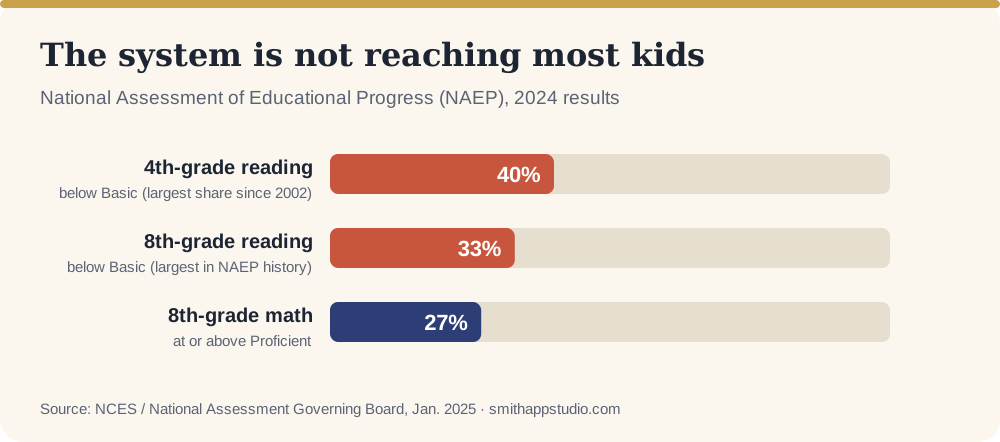
| 40% | 4th graders reading below Basic | NAEP 2024 |
| 27% | 8th graders proficient in math | NAEP 2024 |
| 94% | Alpha students who say they love school | Love School |
The founder
MacKenzie Price is a Stanford-trained psychologist and a mother whose daughters went from curious to bored at a top-rated school. Her public profile sums up what she did next: "School wasn't working for my kid so I co-founded my own."
She and Brian Holtz started Alpha in Austin in 2014. The model, which she calls 2 Hour Learning, uses personalized software so each child masters core subjects at their own pace. A student moves forward only once they have learned the material. The time saved goes to the skills that traditional school rarely makes room for.
Alpha Chicago, by the numbers
Alpha Chicago opened on September 8, 2026 at 350 East South Water Street in the Loop. Reporting from Block Club Chicago and Alpha's announcement fills in the picture:
| Grades | PreK through 8th |
| Planned opening class | About 100 students |
| Core academics | About 2 hours a day, mastery-based |
| Academic programs | Alpha's own platform plus Khan Academy, Membean, Mentava and MobyMax |
| Afternoon workshops | Life Skills Workshops: public speaking, entrepreneurship, teamwork, leadership, financial and tech literacy |
| Adults in the room | "Guides" who coach and motivate, starting at $100,000 |
| Homework and textbooks | None |
| Tuition | $55,000 a year |
| Network size | Campuses in 17 states plus Puerto Rico (locations) |
Why the afternoons are the real story
Every serious platform in the digital economy depends on people who can do three things: explain an idea, build something useful and handle money responsibly. Those used to be skills people picked up in their twenties, if ever. Alpha teaches them in elementary school.
Think about what a child learns from managing a short-term rental listing. They learn how to write a description that sells, how to price against the market, and how to handle a review. Those are the same skills behind every creator storefront, every digital-goods marketplace and every virtual space that has to earn its keep. A child who has shipped an app at ten does not fear the tools at twenty. They see them as materials to build with.
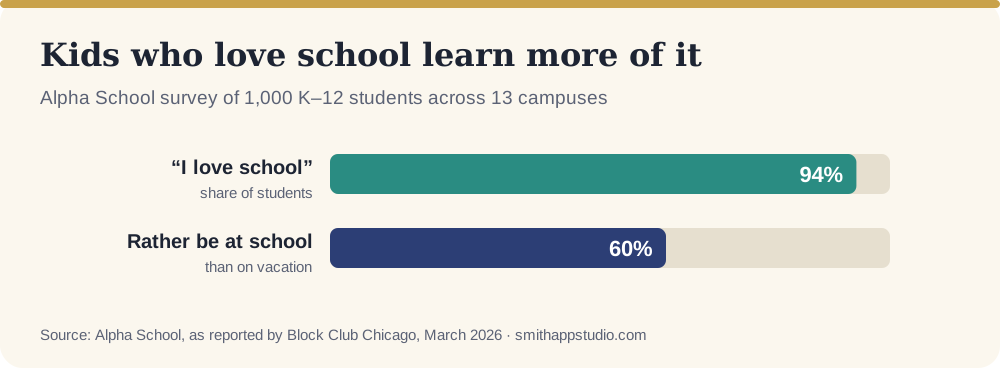
The engagement data backs this up. In an Alpha survey of 1,000 students across 13 campuses, 94% said they love school, and 60% said they would rather be at school than on vacation.
The research underneath the mornings
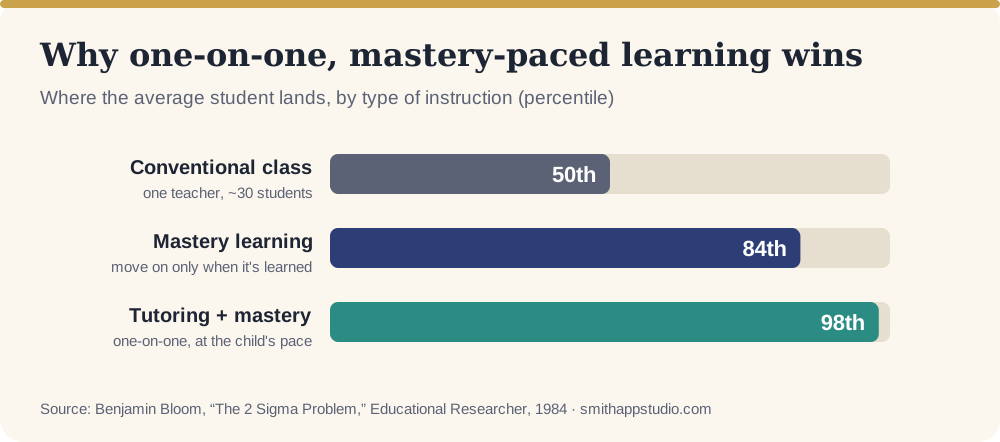
The two-hour academic block stands on a Chicago foundation. In 1984, University of Chicago researcher Benjamin Bloom published the "2 Sigma Problem." He showed that the average student who was tutored one-on-one, and allowed to master each step, outperformed about 98% of students in a conventional class. The catch was that nobody could afford a tutor for every child. Personalized software is the first real attempt to close that gap at scale.
Recent independent evidence points the same direction. A 2025 randomized trial in a Harvard physics course found students learned more than twice as much with an AI tutor as in a strong active-learning class, in less time.
Alpha reports that its classes score in the top 1–2% nationally on MAP tests. Those claims are being examined closely: an October New York Times analysis found that 42% of students hit the full "2x" growth target in both subjects. That scrutiny is healthy, and it is how a bold model gets sharper.
The gap Alpha is pushing against
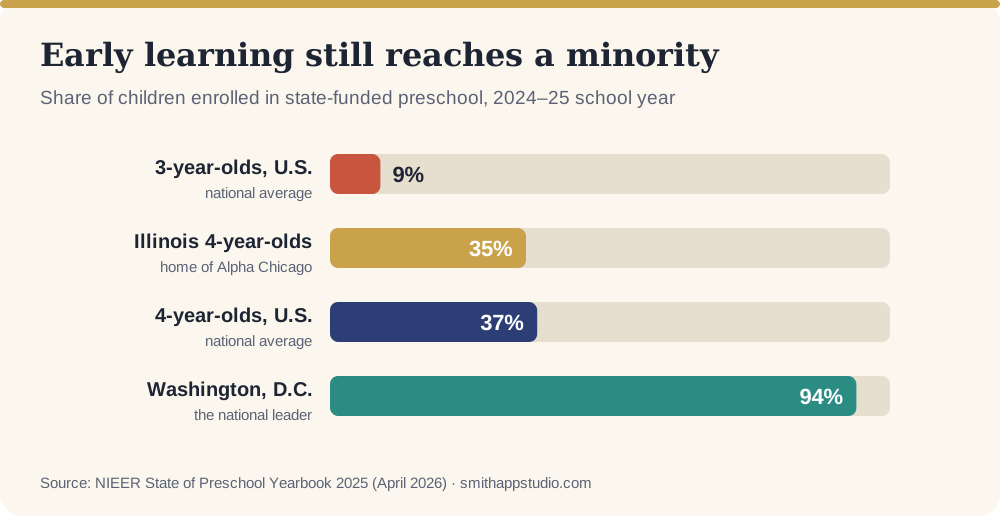
The evidence for starting early is overwhelming. Nobel laureate James Heckman, also of the University of Chicago, found that high-quality programs from birth to age five return about 13% a year. Yet NIEER reports that state preschool reached only 37% of 4-year-olds and 9% of 3-year-olds in 2024–25.
The cost of that gap shows up in the 2024 Nation's Report Card: 40% of fourth graders read below the Basic level, and only 27% of eighth graders are proficient in math.
Young people are naturally brilliant. When the system waits too long and cuts early programs, it wastes that brilliance. MacKenzie Price is showing what happens when you don't.
Alpha's programs, in one place
- Alpha Chicago, with virtual information sessions on November 11 and 18 and the Chicago application
- The Program: Love School, Learn 2x in 2hrs and Learn Life Skills
- Life Skills Workshops and the video library
- 2 Hour Learning, Alpha High School and Alpha Anywhere
- Admission, the FAQ and Bring Alpha to My City
What it means for the next internet
The children in Alpha's workshops today will be building the platforms, storefronts and virtual worlds of the 2040s. They will expect to own what they make, and they will expect their record of learning to belong to them. That is a question we explored in who owns the learning record, and it matters even more for a generation that starts building this young.
For the full story, see Smith App Studio's Journal tribute to MacKenzie Price and Alpha Chicago. For families who want to bring the mastery habit home, ExamPilot breaks down five things to borrow tonight.
MacKenzie, thank you. Keep building geniuses.