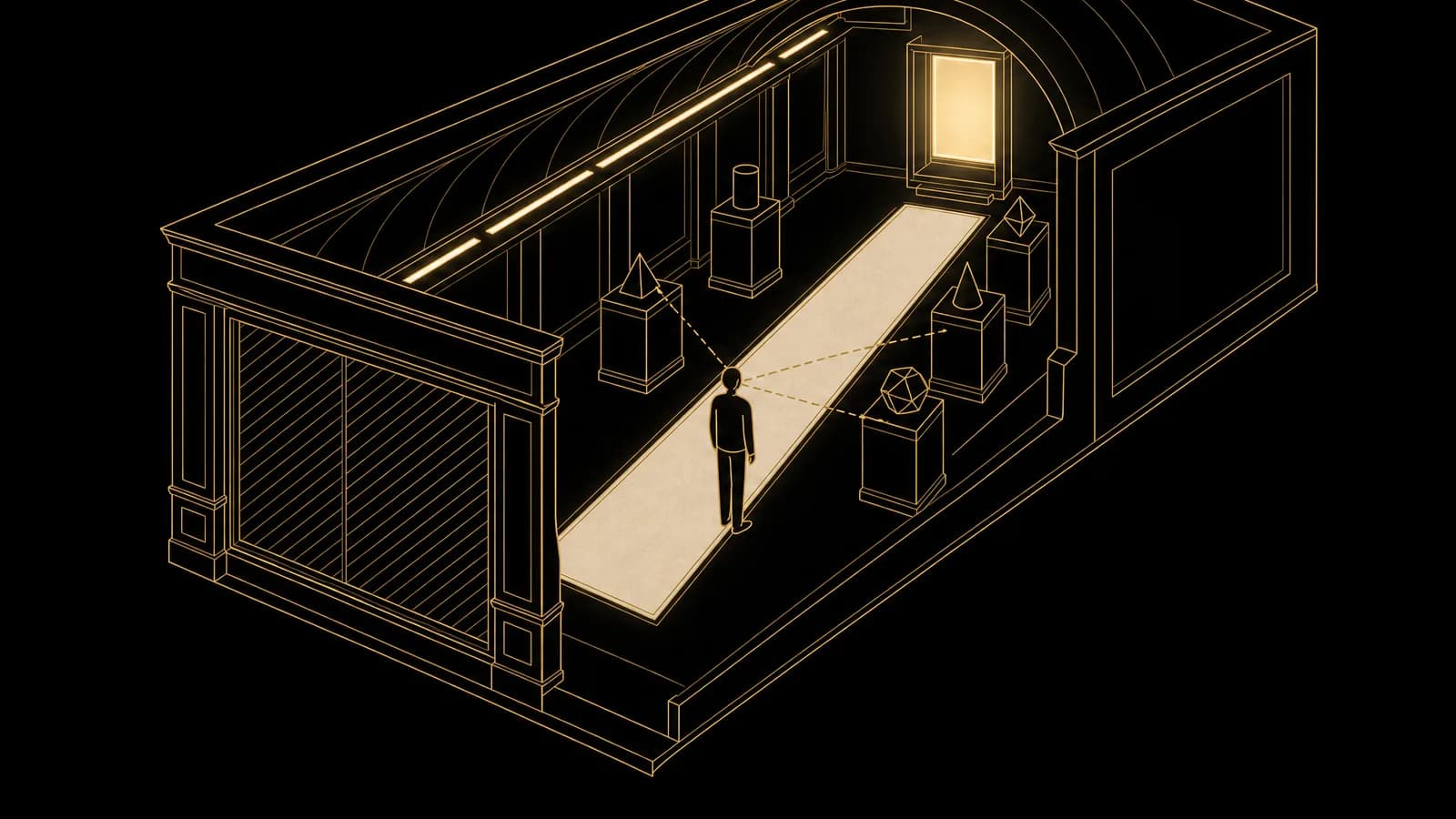
Most pitches for a virtual space lead with the spectacle. The question an owner actually asks is narrower, and harder: what does it return?
Here is the honest version, with a storefront that opened this week as the worked example. Smith App Studio has built Meridian Row, a lamplit boutique where every product is a real object standing on its own plinth. The shop is a demonstration — nothing is for sale — but every mechanism in it is real.
It closes the gap photographs leave open
A product photograph answers one question, from one angle, under light somebody else chose. What a buyer wants to know is what the thing is like — and the angle nobody shot is reliably the one they wondered about. Size, against a white background, is a guess.
In a space none of that holds. The object has a true size and the visitor has a true height standing beside it: they crouch to it, turn it over, bring it close enough to see how it is made. That gap between the picture and the thing is where a large share of returns come from, and a return is paid for twice — once in the logistics, and once in a customer who decides the risk is not worth repeating.
A page is compared; a place is visited
Pages are opened in tabs, lined up side by side, and settled on price. A place is not compared that way. It is entered, remembered, and — the part that actually matters commercially — it is forwarded. A link to a room gets opened in a meeting to show a colleague what you do. A product grid never has.
One URL, every device
The reason this is not a 2017 argument is WebXR, the browser's own standard for 3D and headsets. A well-built space opens from an ordinary link, in the browser already on the device: touch to walk on a phone, the keyboard on a laptop, full immersion and hand tracking in a headset. No app, no store listing, no account.
That makes a space a distribution asset rather than a destination. It can sit behind a QR code in a window, a line in an email signature, a tablet at a trade show, or a message sent at eleven at night.
If it does not read a catalogue, it is a diorama
The failure mode of immersive retail is a beautiful room that is wrong the week a product changes. A space that earns its keep is generated from the product list: each item carries its own name, price, model and position, so adding or repricing one is configuration rather than a rebuild. In Meridian Row even the film playing on the back wall renders from that same list.
Ask any vendor how a product gets added. If the answer involves them, you are buying a diorama.
What you hold at the end
A space is made of assets — the models, the materials, the room itself — and most of the commercial value sits in whether you own them. A 3D model of your product has a working life well beyond one storefront: an augmented-reality view on a customer's own floor, a turntable on an ordinary product page, a partner's world, a marketplace listing. Commissioned under a platform's terms and delivered only inside it, that same model cannot move when the relationship ends.
Smith App Studio's position is the one worth borrowing: fixed scope, and the client keeps the world, the models and the source files. Their own account of the commercial case is what a walkable store actually does for a business.
Where it does not pay
Considered purchases, where the detail carries the value: furniture, lighting, footwear, jewellery, instruments, fixtures, equipment too large to take to a trade show, and anything that is currently sold by getting a person into a showroom. It is a poor instrument for a large catalogue of low-margin commodity goods, where a conventional storefront converts better and costs less. A space is not a cheaper shop; it is a better one for a particular kind of decision.
Three questions, in that order
Not "what will it look like", but: what does it do that a page cannot, how does it stay current, and what do we own when it is finished? A vendor who answers all three plainly is selling infrastructure. One who only answers the first is selling a set.