Somnium Space: What Owning Land in a VR-First World Feels Like
Most virtual worlds added VR support. Somnium Space started there. That ordering sounds like trivia until you put a headset on inside it, at which point it explains almost everything — the scale of the terrain, the pace of movement, the way buildings are sized for a body rather than a camera.
It is a persistent, open, social world where the land is owned by the people in it, and it has been grinding away at that idea for years.
Parcels in an open world
Land in Somnium Space is sold as parcels of varying sizes — commonly small, medium and extra-large tiers — each held as an NFT on Ethereum and tradable on markets such as OpenSea. Bigger parcels carry more build volume; smaller ones are an accessible way in.
The important word is open. The map is one continuous world rather than a menu of disconnected rooms. You move from your parcel to your neighbour's without a loading screen in between, and that continuity is what makes it feel like a place rather than a website with 3D on it.
- Persistence — what you build stays built, whether or not you are logged in.
- Continuity — neighbours are genuinely adjacent, so location has consequences.
- Presence — in a headset, a parcel is experienced at human scale, not viewed.
- Portability — the deed lives in your wallet, so it moves when you do.
The CUBE token functions as in-world currency, and the project has pursued a hardware-forward direction, including exploring its own PC VR headset. Treat that as ambition rather than fixed promise — the durable point is a team that thinks in headsets first.
What full immersion actually changes
Ownership in VR lands differently, and it is worth being specific rather than mystical about why.
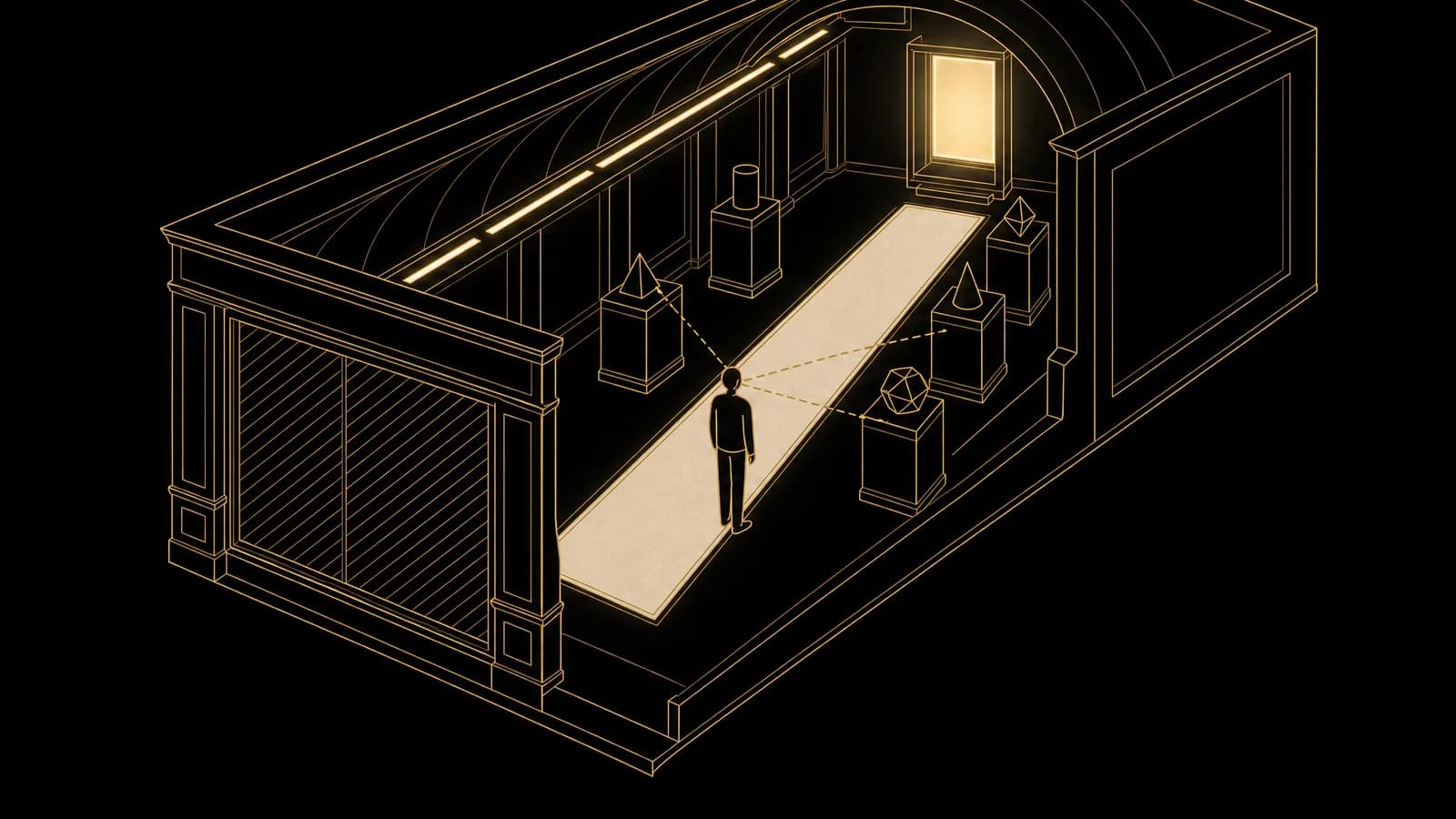
Scale becomes real. A ceiling height you chose on a floor plan is something you stand under. A gallery that looked spacious in a browser can feel claustrophobic at eye level. Builders in Somnium develop an architect's instincts fast, because the medium punishes bad proportions immediately.
Social weight becomes real too. Two avatars at conversational distance, with voice and head movement, produce something a video call does not. Events feel attended rather than watched. That is the argument for owning a venue in a VR-first world: you are not renting eyeballs, you are hosting people.
The trade-off, honestly stated, is reach. Headsets — whether standalone hardware like Meta Quest or PC-tethered rigs — are a smaller audience than browser tabs, even as open standards like WebXR narrow the gap. We compared the paths in VR versus AR for digital assets; for most creators the answer is both. Follow @SomniumSpace for how the world develops.
Where Nexaria Digital fits
Nexaria Digital publishes walkable 3D showrooms that open in a browser and in VR from the same link, so a headset-native experience does not cost you the laptop audience. We pair that with photoreal 3D scans and Gaussian-splat captures, leasing listings for parcel owners with space to rent, and Fan Passes for recurring supporter income. Pricing is on our pricing page; finished spaces live in the showcase.
Land you can stand on is a different asset from land you can click. Somnium bet early on that distinction.
This post is educational, not financial advice — always do your own research. Platform details come from public pages linked above and may evolve; corrections are welcome at our contact page.